Trick or Treat 2026
Flash Fiction!
Every day this year in October, I challenged myself to write a flash fiction piece of 500 words or less. Enjoy the stories! Every week, I will update it with more.
Subscribe on Substack to get the stories as soon as they are released!
I hope you enjoy them! Happy Halloween! :)

October 1st,
The Watcher
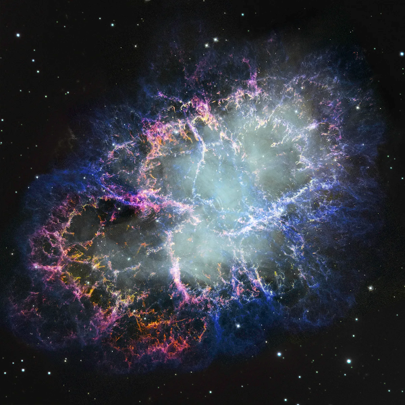
The image in this post is of the Crab Nebula captured in 1999/2000 by the Hubble Space Telescope, reprocessed in 2026. Credit: NASA, ESA, STScI, W. Blair (JHU). Image Processing: J. DePasquale (STScI)
Divorce has a funny way of forcing you to reinvent yourself. I bought a 10-inch reflector telescope to escape the routine of middle-aged loneliness and lean into my newfound freedom. Nothing fancy, but it was powerful enough to resolve plenty of interesting stellar objects under dark and clear skies. That is how, one moonless summer night, I ended up alone at Blue Springs State Park, surrounded by miles of silent pine woods.
The setup was tranquil as I drank in the vibrant gradient of orange and violet colors dimming on the horizon. I aligned the scope, took in the beauty of Saturn's rings, and the pale, cream-colored swirls of gas on the rotating sphere. Then, I refocused the mirrors and let my eyes rest on the brilliant lights emanating from the Mizar and Alcor visual binary star system, marveling at the clean split stars against the darkness. Finally, I adjusted the telescope to bring Messier 1, the Crab Nebula, into focus.
I expected the diffuse, ghostly smudge described in observer guides. Instead, as the optics resolved on the object, my breath got caught in my throat.
The gaseous filaments didn't look like expanding stellar debris. They formed an intricate, webbed lattice that resembled a delicate ring of iris stroma around a dark center. It was unmistakable: a great, vast eye, ancient and suspended in the deep void of space. I leaned closer to the eyepiece, convincing myself it was an optical illusion.
Then, the central light began to pulse in rapid succession.
It wasn't a steady, mindless rhythm. Instead, the brilliant point of light dilated, adjusting its focal depth until it locked directly onto my lens. Onto me. Cold sweat broke across my neck. A terrible certainty settled in my chest. The light seemed to work both ways. As if the moment a photon of energy hit my retina, a circuit completed and a signal was sent back to whatever was leering at me.
The pupil widened. The faint web of gas around it stretched and surged forward, expanding exponentially faster than any physical law allowed. It wasn't just growing. It was closing distance. I shoved the telescope over, knocking it hard into the grass, then scrambled into my truck and drove the six hours home in complete silence, refusing to look up at the sky.
That was three nights ago. But tonight, standing in my bedroom with the lights off and the blinds drawn, the room isn't dark. A faint, rhythmic pulse of pale light is washing through the glass, casting long, webbed shadows against my wall.
It found the way down, to me.
October 2nd,
Call of the Deep
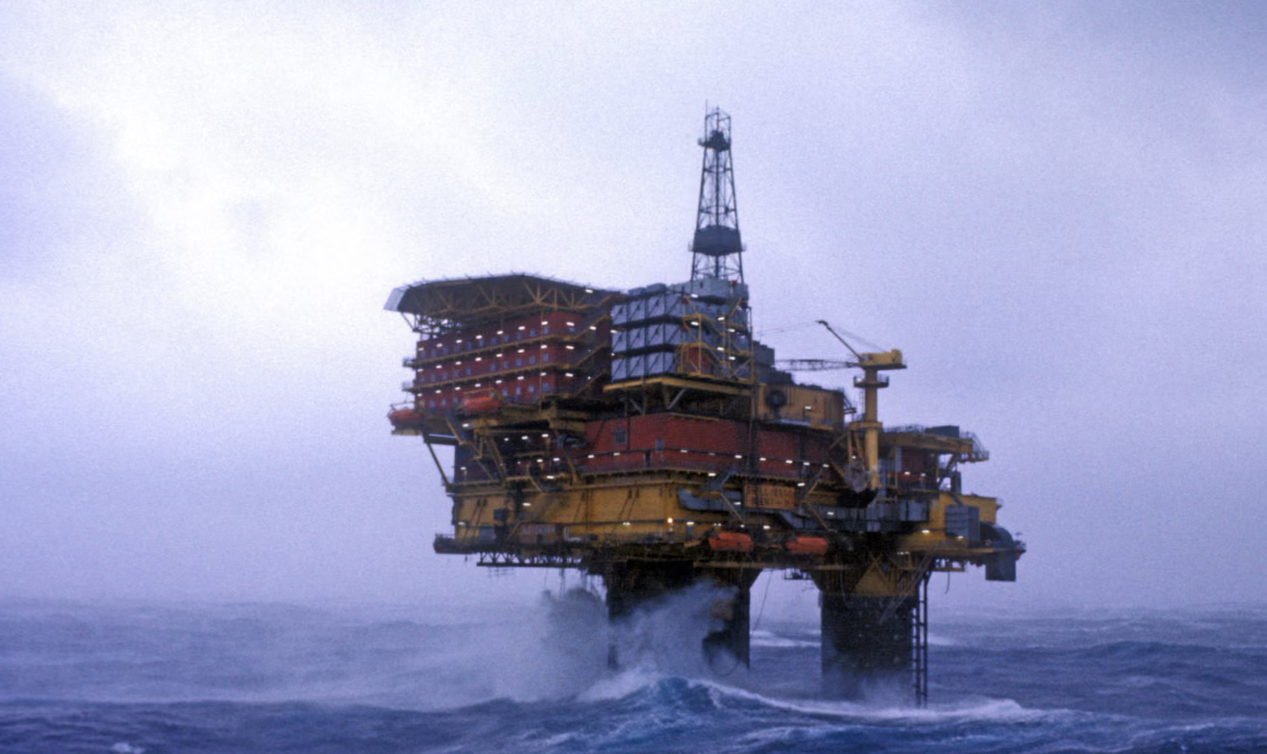
Photo by Brian Jobson/Alamy.
2:03 AM. The middle of the Gulf of Mexico.
A thin blue glow illuminated the cramped control module. Peyton shook her head to the heavy metal beats in her headphones until a crimson warning light flashed across the console’s screen. She slid off her headset and leaned in. Peyton let out a heavy sigh as she looked over the error message. She had encountered plenty of errors with the equipment before, but she had never seen a message like this one. She ran a more detailed diagnostic report. The rig was designed to chew through basalt, yet the drill bit had struck something harder than solid rock. According to the geological bedrock report on her console, whatever was down there had been sealed under miles of stone for at least twenty-three million years.
She knew the protocol; she needed to phone this in to report it to the higher-ups so they could decide what to do. But before she did, curiosity got the better of her. She pulled up the vibration sensors attached directly above the drill head. The sonogram wave functions weren’t showing mechanical stress. They were showing a rhythm. A slow, agonizingly deliberate pulse, like a massive, heavy lung expanding and contracting against the steel.
Then the telemetry data updated. The pressure wasn’t coming from the rig pushing down. Instead, something beneath the bedrock was now pushing back.
Cold sweat broke out across Peyton’s neck. Her heart rate increased. She switched her monitor feed to the deep-water camera positioned at the bore entrance. She needed to see what this anomaly was.
The screen flickered with static. Then an image appeared as the floodlights kicked on. Through the murky abyss, thick, cinder-black tendrils were wrapped around the drill bit. They weren’t just stopping it. They pulsed as if absorbing the heat of friction and using it to multiply rapidly. A dozen pale, unblinking irises split open along the black masses, staring directly up into the camera lens.
A second later, a low-frequency acoustic shockwave traveled miles up the drill, shaking it violently.
The monitor’s feed cut out.
On her desk, the analog seismograph began to print frantically, its needle whipping back and forth so hard it snapped. Beneath her feet, the ocean floor didn’t just shake; it groaned, a deep bellow that vibrated straight through the steel deck and into her bones.
The power cut out, plunging the control room into total darkness. Then the rig lurched violently as thousands of tons of steel began tearing apart, pulled down into the turbulent waves.
October 3rd,
The Reuleaux Field
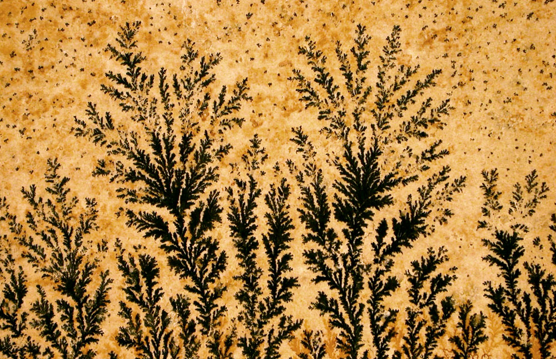
Photograph of geological dendrites taken by Mark A. Wilson
The farm off the old Pleasant Valley Road had seen better days. Three hundred acres of corn once rustled in the summer breeze. But fertilizer had quadrupled in price while fuel surged, and the soil was left to go fallow.
Mr. Hoover walked through the wild growth and shook his head in disappointment. Weeds and native grasses blanketed the soil in a patchwork of fresh greenery everywhere he looked; well, everywhere but one patch of soil that remained bare. Far out in the third field plot, a Reuleaux triangle had formed in the Earth. Mr. Hoover was perplexed. Never in his life had he seen such a strange rounded triangular shape appear in his field. He bent down to inspect the edge of the anomaly, and his head accidentally passed over the edge of the shape.
Mr. Hoover felt an intense weight in his head and plummeted face-first, and his cheek pressed hard against the soil on his right side. At first, he believed he had tripped. When he moved his arms to push himself back up, he couldn’t move from the spot, as if the air above him had suddenly gained the mass of lead. He planted his palms in the weeds outside the perimeter and shoved with everything he had, but his skull remained welded to the Earth.
Sweat rolled down his face. He screamed as loud as he could, but the farmhouse and his beloved wife were well out of earshot. He spent the afternoon trying his best to escape, but every attempt failed; he was stuck, or at least his head was.
The sun had dropped below the horizon, and the sky turned an ominous red as he looked out into the center of the shape.
At first, he thought delirium was setting in, as he watched what looked like a strange hair-thin blue aperture open at the center of the shape. Yet, delirium didn’t explain the three chartreuse appendages which reached out from the tear in the loam and wriggled unnaturally.
Mr. Hoover screamed as the entity dragged itself into the open air. His eyes throbbed as they tried to focus on the unsettling geometry that flickered like a flat shadow cast by a shape moving through unseen higher spaces.
The visitor made no sound as it drifted effortlessly across the Reuleaux field toward the pinned man.
Hours later, Mrs. Hoover finally found her husband in the harsh beam of her flashlight. Or, more accurately, she found his body. Where his head should have been, a network of red, branching, tree-like fractal dendrites was pressed into the dirt. The crystalline structures connected to his neck were stamped into the topsoil like ink on parchment.
The worst part? Somehow, Mr. Hoover’s chest still rose and fell.
October 4th,
Petri Dish
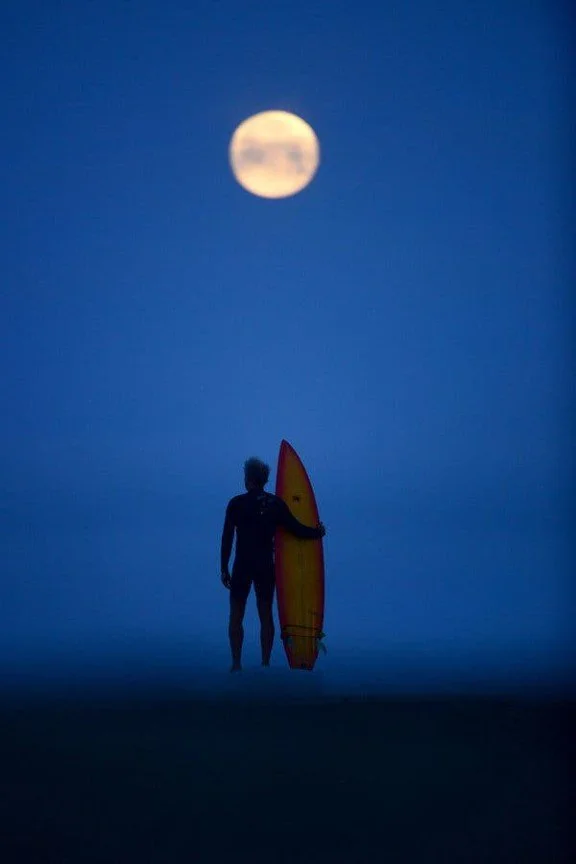
Photo from this NYTimes article: “https://www.nytimes.com/2017/04/21/learning/what-work-sport-or-pastime-do-you-like-to-do-at-night.html”
Surfing was how I kept my father with me. Out on Honolua Bay, as my board glided over the Pacific, my mind melded seamlessly into the sea. The warm sunlight, the smell of salt and board wax, the ocean’s sheer majesty became my refuge from the world. Until the sky broke.
I was paddling out, counting clouds as I waited for a swell, when I looked up at the winter moon.
For a terrifying ten seconds, it vanished. It was erased from the sky in the blink of an eye. The air pressure plunged instantly, popping my ears and slamming a wave of dizzying nausea into my skull. My ears rang violently as fresh blood dripped from my nose. An eerie silence fell over the bay as the wind instantly died.
Then, it reappeared.
It didn’t just return; it swelled to twice its visual size, looming over the ocean like a bloated, glowing moon jellyfish.
Within minutes, the sea began to wither. Millions of gallons of coastal water were drawn violently outward by the colossal surge in gravity. The water beneath my board drained away so fast the ocean floor turned into an exposed, dripping desert. My board slammed hard into a web of sharp finger coral, trapping my legs. Fish flopped helplessly in shallow puddles around me as the reef dried out under the oppressive lunar glare.
The island groaned.
The sudden gravitational wrenching tore open the seabed. The ground beneath the coral violently shuddered, erupting into fresh, boiling streams of black basaltic lava. Water hitting the molten rock exploded into vast columns of briny, scalding steam. Trapped on my perch, I huddled above the glowing lava, praying for a rescue helicopter. But I knew the truth. This was happening everywhere. No one was coming.
Then, I saw it on the horizon
It wasn’t a tsunami. It was a mountain-high mega-tidal wall of water, hurtling back to reclaim the land at an impossible speed. The sound was a deafening roar that threatened to rattle my bones to dust.
Tears spilled down my cheeks as I looked back up at the colossal white orb hanging in the sky. I felt microscopic. A tiny organism trapped in a petri dish, and the moon was the microscope lens looking down as the slide was about to be sterilized.
I tucked into a ball and closed my eyes. The agony was unbearable. Trapped. Just waiting for the inevitable surge to snuff me out.
Something had moved the moon, and unfortunately for us, it didn’t care about what was living underneath it.
October 5th,
Orbital Psychosis
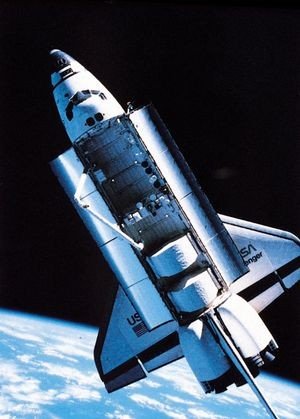
Image photographed on February 7, 1984, by astronaut Bruce McCandless
G-forces crushed my chest with fury as I pierced the stratosphere,
Fearing that a fracture forming soon would strip me from the door—
Though my head spun in the darkness, courage held me, still undone,
Till the ship outran the gravity, leaving Earth forevermore;
Checked display and thruster gauges, far beyond where men explore—
What! A knocking at the door.
Deep in orbit, cold and silent, how could such a sound occur?
I was bound in lonely transit, sole occupant heretofore.
Breaths grew heavy, lungs grew tight, as condensation fogged my view,
While the rhythmic pounding grew, louder, fiercer than before;
Through the void of airless vacuum came a sound I must ignore—
Knocking at the airlock door.
Unbuckled from my padded chair, I floated free in zero-g,
Hands were shaking, palms were sweating, as I drifted toward the rear;
Pounding thundered through the bulkhead, something wanted to get through,
Hoping for a view I knew would bring relief to dread I bore—
Pressed my visor to the portal, hoping darkness lay in store—
Stared eight eyes from outer lore.
Neither plant nor beast nor stark machine was what had held my gaze,
Shifting wildly, weaving chromatic rays in patterns galore;
Fractal iris, isometric-fractured mind no space could save,
In a cold geometric grave, sanity restored no more;
Floating helpless, lost forever, where no human trod before—
Meeting what will end evermore.