Trick or Treat 2026
Flash Fiction!
Every day this year in October, I challenged myself to write a flash fiction piece of 500 words or less. Enjoy the stories! Every week, I will update it with more.
Subscribe on Substack to get the stories as soon as they are released!
I hope you enjoy them! Happy Halloween! :)

October 1st,
The Watcher
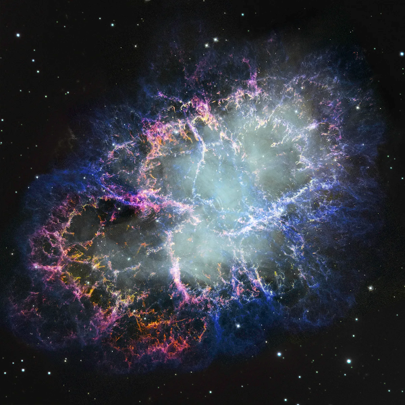
The image in this post is of the Crab Nebula captured in 1999/2000 by the Hubble Space Telescope, reprocessed in 2026. Credit: NASA, ESA, STScI, W. Blair (JHU). Image Processing: J. DePasquale (STScI)
Divorce has a funny way of forcing you to reinvent yourself. I bought a 10-inch reflector telescope to escape the routine of middle-aged loneliness and lean into my newfound freedom. Nothing fancy, but it was powerful enough to resolve plenty of interesting stellar objects under dark and clear skies. That is how, one moonless summer night, I ended up alone at Blue Springs State Park, surrounded by miles of silent pine woods.
The setup was tranquil as I drank in the vibrant gradient of orange and violet colors dimming on the horizon. I aligned the scope, took in the beauty of Saturn's rings, and the pale, cream-colored swirls of gas on the rotating sphere. Then, I refocused the mirrors and let my eyes rest on the brilliant lights emanating from the Mizar and Alcor visual binary star system, marveling at the clean split stars against the darkness. Finally, I adjusted the telescope to bring Messier 1, the Crab Nebula, into focus.
I expected the diffuse, ghostly smudge described in observer guides. Instead, as the optics resolved on the object, my breath got caught in my throat.
The gaseous filaments didn't look like expanding stellar debris. They formed an intricate, webbed lattice that resembled a delicate ring of iris stroma around a dark center. It was unmistakable: a great, vast eye, ancient and suspended in the deep void of space. I leaned closer to the eyepiece, convincing myself it was an optical illusion.
Then, the central light began to pulse in rapid succession.
It wasn't a steady, mindless rhythm. Instead, the brilliant point of light dilated, adjusting its focal depth until it locked directly onto my lens. Onto me. Cold sweat broke across my neck. A terrible certainty settled in my chest. The light seemed to work both ways. As if the moment a photon of energy hit my retina, a circuit completed and a signal was sent back to whatever was leering at me.
The pupil widened. The faint web of gas around it stretched and surged forward, expanding exponentially faster than any physical law allowed. It wasn't just growing. It was closing distance. I shoved the telescope over, knocking it hard into the grass, then scrambled into my truck and drove the six hours home in complete silence, refusing to look up at the sky.
That was three nights ago. But tonight, standing in my bedroom with the lights off and the blinds drawn, the room isn't dark. A faint, rhythmic pulse of pale light is washing through the glass, casting long, webbed shadows against my wall.
It found the way down, to me.
October 2nd,
Call of the Deep
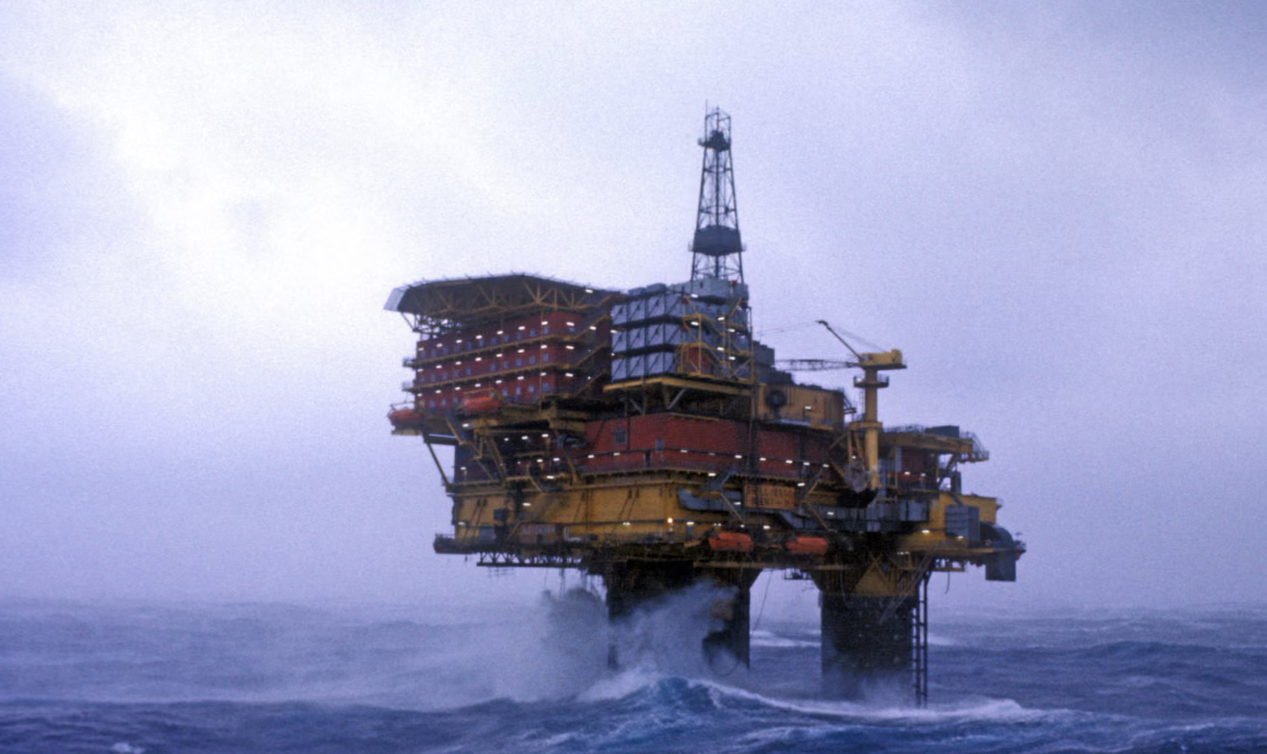
Photo by Brian Jobson/Alamy.
2:03 AM. The middle of the Gulf of Mexico.
A thin blue glow illuminated the cramped control module. Peyton shook her head to the heavy metal beats in her headphones until a crimson warning light flashed across the console’s screen. She slid off her headset and leaned in. Peyton let out a heavy sigh as she looked over the error message. She had encountered plenty of errors with the equipment before, but she had never seen a message like this one. She ran a more detailed diagnostic report. The rig was designed to chew through basalt, yet the drill bit had struck something harder than solid rock. According to the geological bedrock report on her console, whatever was down there had been sealed under miles of stone for at least twenty-three million years.
She knew the protocol; she needed to phone this in to report it to the higher-ups so they could decide what to do. But before she did, curiosity got the better of her. She pulled up the vibration sensors attached directly above the drill head. The sonogram wave functions weren’t showing mechanical stress. They were showing a rhythm. A slow, agonizingly deliberate pulse, like a massive, heavy lung expanding and contracting against the steel.
Then the telemetry data updated. The pressure wasn’t coming from the rig pushing down. Instead, something beneath the bedrock was now pushing back.
Cold sweat broke out across Peyton’s neck. Her heart rate increased. She switched her monitor feed to the deep-water camera positioned at the bore entrance. She needed to see what this anomaly was.
The screen flickered with static. Then an image appeared as the floodlights kicked on. Through the murky abyss, thick, cinder-black tendrils were wrapped around the drill bit. They weren’t just stopping it. They pulsed as if absorbing the heat of friction and using it to multiply rapidly. A dozen pale, unblinking irises split open along the black masses, staring directly up into the camera lens.
A second later, a low-frequency acoustic shockwave traveled miles up the drill, shaking it violently.
The monitor’s feed cut out.
On her desk, the analog seismograph began to print frantically, its needle whipping back and forth so hard it snapped. Beneath her feet, the ocean floor didn’t just shake; it groaned, a deep bellow that vibrated straight through the steel deck and into her bones.
The power cut out, plunging the control room into total darkness. Then the rig lurched violently as thousands of tons of steel began tearing apart, pulled down into the turbulent waves.
October 3rd,
The Reuleaux Field
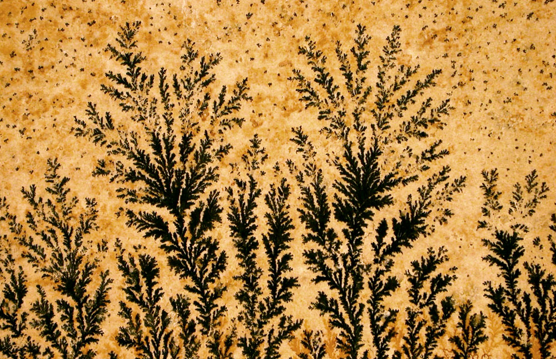
Photograph of geological dendrites taken by Mark A. Wilson
The farm off the old Pleasant Valley Road had seen better days. Three hundred acres of corn once rustled in the summer breeze. But fertilizer had quadrupled in price while fuel surged, and the soil was left to go fallow.
Mr. Hoover walked through the wild growth and shook his head in disappointment. Weeds and native grasses blanketed the soil in a patchwork of fresh greenery everywhere he looked; well, everywhere but one patch of soil that remained bare. Far out in the third field plot, a Reuleaux triangle had formed in the Earth. Mr. Hoover was perplexed. Never in his life had he seen such a strange rounded triangular shape appear in his field. He bent down to inspect the edge of the anomaly, and his head accidentally passed over the edge of the shape.
Mr. Hoover felt an intense weight in his head and plummeted face-first, and his cheek pressed hard against the soil on his right side. At first, he believed he had tripped. When he moved his arms to push himself back up, he couldn’t move from the spot, as if the air above him had suddenly gained the mass of lead. He planted his palms in the weeds outside the perimeter and shoved with everything he had, but his skull remained welded to the Earth.
Sweat rolled down his face. He screamed as loud as he could, but the farmhouse and his beloved wife were well out of earshot. He spent the afternoon trying his best to escape, but every attempt failed; he was stuck, or at least his head was.
The sun had dropped below the horizon, and the sky turned an ominous red as he looked out into the center of the shape.
At first, he thought delirium was setting in, as he watched what looked like a strange hair-thin blue aperture open at the center of the shape. Yet, delirium didn’t explain the three chartreuse appendages which reached out from the tear in the loam and wriggled unnaturally.
Mr. Hoover screamed as the entity dragged itself into the open air. His eyes throbbed as they tried to focus on the unsettling geometry that flickered like a flat shadow cast by a shape moving through unseen higher spaces.
The visitor made no sound as it drifted effortlessly across the Reuleaux field toward the pinned man.
Hours later, Mrs. Hoover finally found her husband in the harsh beam of her flashlight. Or, more accurately, she found his body. Where his head should have been, a network of red, branching, tree-like fractal dendrites was pressed into the dirt. The crystalline structures connected to his neck were stamped into the topsoil like ink on parchment.
The worst part? Somehow, Mr. Hoover’s chest still rose and fell.
October 4th,
Petri Dish
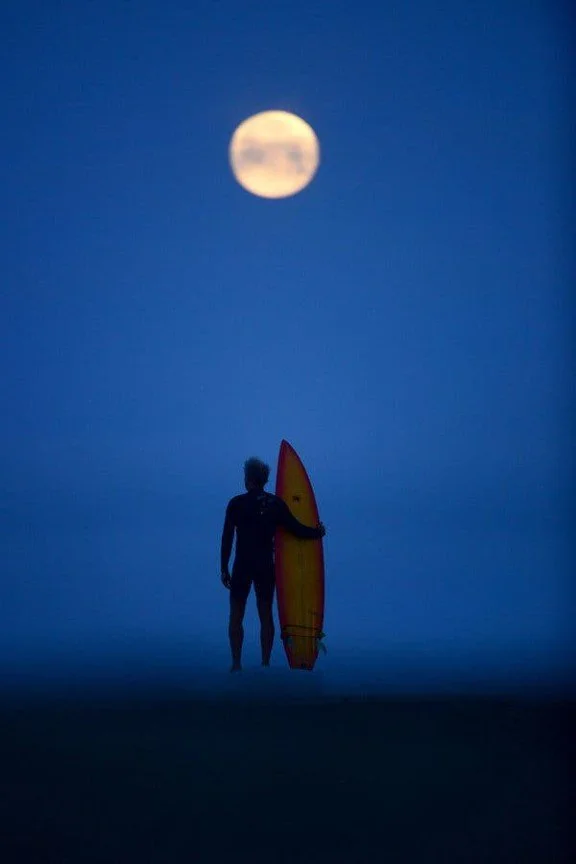
Photo from this NYTimes article: “https://www.nytimes.com/2017/04/21/learning/what-work-sport-or-pastime-do-you-like-to-do-at-night.html”
Surfing was how I kept my father with me. Out on Honolua Bay, as my board glided over the Pacific, my mind melded seamlessly into the sea. The warm sunlight, the smell of salt and board wax, the ocean’s sheer majesty became my refuge from the world. Until the sky broke.
I was paddling out, counting clouds as I waited for a swell, when I looked up at the winter moon.
For a terrifying ten seconds, it vanished. It was erased from the sky in the blink of an eye. The air pressure plunged instantly, popping my ears and slamming a wave of dizzying nausea into my skull. My ears rang violently as fresh blood dripped from my nose. An eerie silence fell over the bay as the wind instantly died.
Then, it reappeared.
It didn’t just return; it swelled to twice its visual size, looming over the ocean like a bloated, glowing moon jellyfish.
Within minutes, the sea began to wither. Millions of gallons of coastal water were drawn violently outward by the colossal surge in gravity. The water beneath my board drained away so fast the ocean floor turned into an exposed, dripping desert. My board slammed hard into a web of sharp finger coral, trapping my legs. Fish flopped helplessly in shallow puddles around me as the reef dried out under the oppressive lunar glare.
The island groaned.
The sudden gravitational wrenching tore open the seabed. The ground beneath the coral violently shuddered, erupting into fresh, boiling streams of black basaltic lava. Water hitting the molten rock exploded into vast columns of briny, scalding steam. Trapped on my perch, I huddled above the glowing lava, praying for a rescue helicopter. But I knew the truth. This was happening everywhere. No one was coming.
Then, I saw it on the horizon
It wasn’t a tsunami. It was a mountain-high mega-tidal wall of water, hurtling back to reclaim the land at an impossible speed. The sound was a deafening roar that threatened to rattle my bones to dust.
Tears spilled down my cheeks as I looked back up at the colossal white orb hanging in the sky. I felt microscopic. A tiny organism trapped in a petri dish, and the moon was the microscope lens looking down as the slide was about to be sterilized.
I tucked into a ball and closed my eyes. The agony was unbearable. Trapped. Just waiting for the inevitable surge to snuff me out.
Something had moved the moon, and unfortunately for us, it didn’t care about what was living underneath it.
October 5th,
Orbital Psychosis
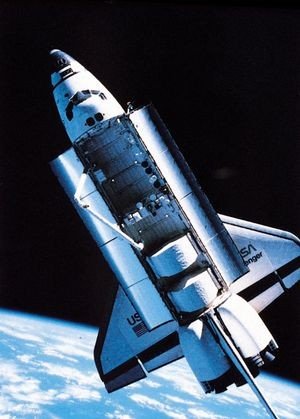
Image photographed on February 7, 1984, by astronaut Bruce McCandless
G-forces crushed my chest with fury as I pierced the stratosphere,
Fearing that a fracture forming soon would strip me from the door—
Though my head spun in the darkness, courage held me, still undone,
Till the ship outran the gravity, leaving Earth forevermore;
Checked display and thruster gauges, far beyond where men explore—
What! A knocking at the door.
Deep in orbit, cold and silent, how could such a sound occur?
I was bound in lonely transit, sole occupant heretofore.
Breaths grew heavy, lungs grew tight, as condensation fogged my view,
While the rhythmic pounding grew, louder, fiercer than before;
Through the void of airless vacuum came a sound I must ignore—
Knocking at the airlock door.
Unbuckled from my padded chair, I floated free in zero-g,
Hands were shaking, palms were sweating, as I drifted toward the rear;
Pounding thundered through the bulkhead, something wanted to get through,
Hoping for a view I knew would bring relief to dread I bore—
Pressed my visor to the portal, hoping darkness lay in store—
Stared eight eyes from outer lore.
Neither plant nor beast nor stark machine was what had held my gaze,
Shifting wildly, weaving chromatic rays in patterns galore;
Fractal iris, isometric-fractured mind no space could save,
In a cold geometric grave, sanity restored no more;
Floating helpless, lost forever, where no human trod before—
Meeting what will end evermore.
October 6th,
Quiet Child
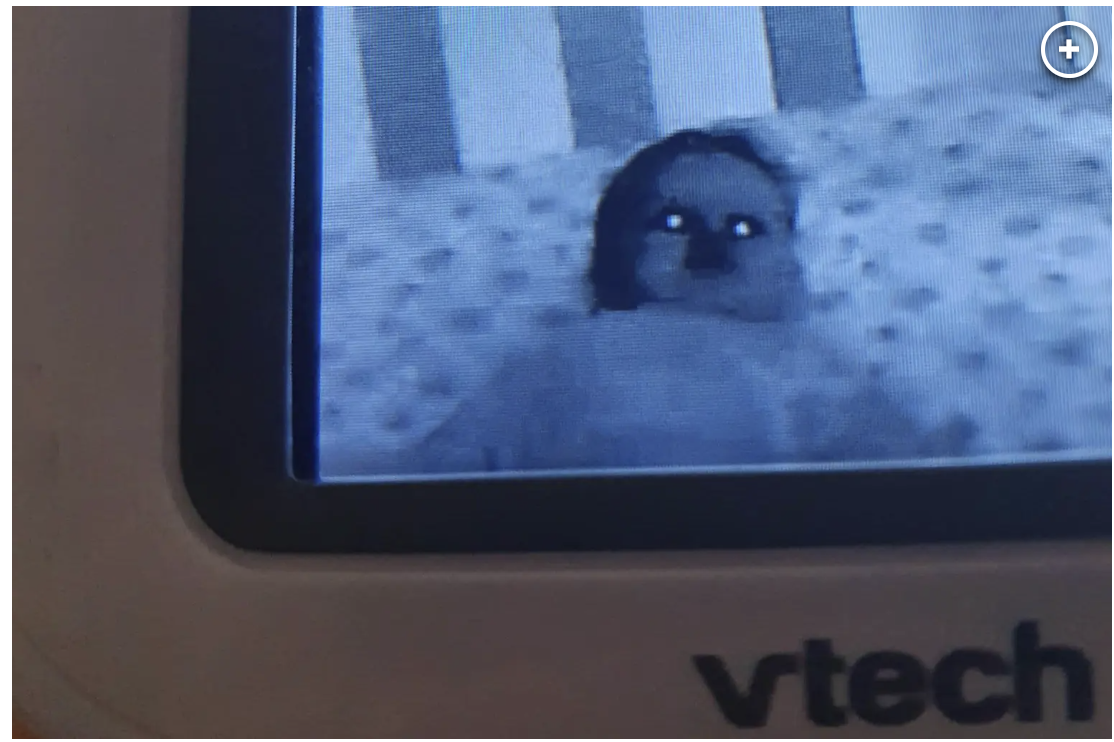
Image from this silly New York Post article: https://nypost.com/2019/11/18/demonic-photo-from-baby-monitor-goes-viral/
No one prepares you for the sheer weight of sleep deprivation. It sits behind your eyes like lead. Time becomes confusing. You can’t remember what you did, and sometimes you dream what you just did in that one hour you managed to fit a nap in. But Oliver was worth it. He was my quiet, perfect baby boy. Too quiet, maybe. He never cried. Not once. Not even when he was born.
By the second week of maternity leave, the static started. I’d be in the kitchen making some dinner for myself when I heard him babble over the monitor. I thought I was dreaming because I heard loud, distinct syllables, as if he were speaking.
When I rushed to his crib, he was lying there in absolute silence, staring at the ceiling. Then I heard the noises again, much louder and worse; his mouth wasn’t moving. The sounds hadn’t come from the air; they had echoed inside my own skull. I shook my head in disbelief, and the noise stopped.
At 2:24 AM, the monitor on my nightstand hissed to life. As usual, I got up to go check on Oliver and see if he was hungry, but I froze at the nursery’s threshold. To my surprise, the speaker wasn’t producing white noise. It was emitting a wet, rhythmic clicking, layered over a cold, mechanical countdown in a language that felt like needles pressing against my eardrums.
My hands quaked as I pressed the power button to turn it off. Yet, the monitor stayed on. So, I flipped it around and took out the batteries, finally quieting the device. That’s when a severe and deep headache brought me to my knees.
On my hands and knees, I dragged myself to the crib to check on Oliver. But as I peeked between the crib’s bars in the darkened room, all I could see were Oliver’s eyes, glowing with a bright cyan light that cast long, distorted shadows across the room. Suddenly, the nightlight burst as every bulb in the house popped all at once.
I clutched my precious boy and hugged him to my chest as I stood up and rushed out of the room. But when I reached the living room, it was already ablaze with blinding light from outside.
Silhouetted against the glass stood six impossibly tall forms. They didn’t open the door. They didn’t shatter the glass. They didn’t need to.
They simply phased through the window as if it were fog, their hideous jointless limbs moving in terrifying synchronicity.
I tried to scream, but my throat was locked. A wave of intense pressure surged behind my forehead. My muscles seized. Tears poured from my eyes and rolled down my cheeks as I stood there frozen. Then the message reverberated in my mind like metal scraping together: RELINQUISH THE NASCENT ONE.
That’s when the dread sank. Unable to pull my arms back, I watched two elongated, quad-digit hands reach forward and lift Oliver from my grip.
I couldn’t blink. I couldn’t fight. All that remained was the blinding light, the scraping in my mind, and the empty nursery as that terrifying, lonely darkness returned.
October 7th,
Solvent

For as long as I can remember, Eklutna Lake felt like a part of me. My father took me ice skating across its glossy surface every winter as I grew up, nested between the mountains just twenty minutes from Anchorage. It was my winter playground as we skidded across the ice playing hockey or tag. Now at the age of ten, I yearned for the winter to come so we could play again under the dazzling display of the northern lights high overhead.
But tonight, something was wrong with the lake.
Two nights ago, a radiant purple streak cut across the sky. My mother called it a shooting star. Tonight, when we stepped onto the dark ice for another family hockey game, a massive hole yawned near the lake's center. My father warned me to stay back, that I could fall in, but I wanted to see what had caused the break in the ice. When the puck broke loose and skidded past the hole, I used it as an excuse to see if Mom's star had landed.
The air stung my lungs, carrying an odd, metallic bite like that of a hot electrical wire mixed with the heavy chlorine smell I remember from my swim lessons at the community indoor pool. I figured this must be what stars smell like as I crept toward the edge of the steaming ice; a strange purple pulse strobed from the depths, causing an iridescent, oily film across the water's surface. Then the water moved in mesmerizing concentric rings and geometric patterns. I bent down for a better look at the water and tried to make out the outline of whatever was flashing below. Was it a satellite? Perhaps a meteor?
Suddenly, the ice cracked and gave way.
I plunged in, bracing for the brutal, heart-stopping cold of an Alaskan lake in midwinter. But the water was warm. So horribly warm, like sinking into a bath. I opened my eyes under the surface. Below me sat a machine drawing in dense streams of water and venting hot, shimmering clouds with every rhythmic pulse of purple light.
Then the itching began.
At first, I thought it was temperature shock. But the searing pain crawled behind my eyes, under my fingernails, inside my ears. Something was entering me. I kicked violently, clawing my way back to the surface and dragging myself onto the slick ice.
Waves of agony shot up my arms. I ripped off my right glove. My fingers were liquefying, sloughing off in a thick, metallic paste that dripped like warm wax, leaving behind nothing but pale, exposed bone.
I opened my mouth to scream for my father, but no sound came out; my jaw had already melted off my face. My vision blurred into a gray haze. My legs went numb; they added to the growing puddle beneath me. My body gave out. The molecules of what was left of me slid quietly back into the warm waters before my parents even understood what had happened.
October 8th,
The Weight of a Grape
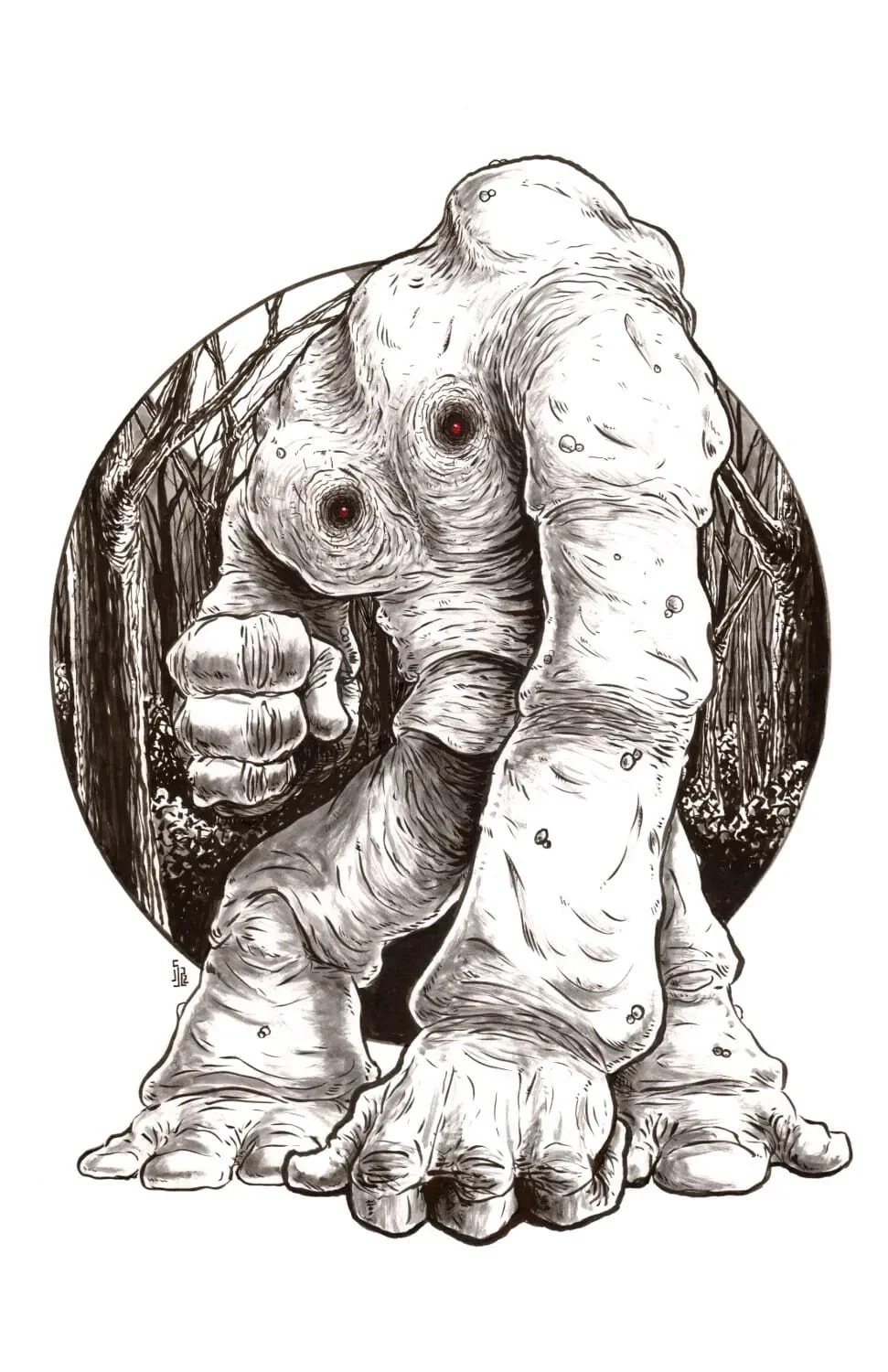
Grafton Monster by artist Jamie Snell
It was the start of buck season; crunchy orange and red leaves covered the ground, and I had just gotten my license to hunt in Taylor County, West Virginia. The bitter November morning brought a chilling fog that soaked the leaves in rich, watery droplets. I set up the salt lick before dawn to account for the prevailing winds and masked my scent by dousing myself with a little vanilla extract. Then I found my spot, covered parts of myself with the wet leaves, and waited as the sun rose.
Brilliant linear rays cut through the canopy, illuminating the white mineral block sitting in the middle of the clearing. I listened to the gentle call of birds and the chittering of squirrels overhead. I was at peace, as I blended into the leaf litter, the tiger in waiting. But suddenly, a hideous, high-pitched whistle followed by a deep, bellowing hum made me clutch my rifle tightly to my chest. The ringing in my head caused waves of pain to cascade down my spine, until the sound stopped as suddenly as it had started.
When I looked up, a colossal, ten-foot-tall, bulky thing stood by the salt block. Strange, rippling muscles covered its back, wrapped in smooth, deep brown-to-grey, seal-like skin. Its forearms were elongated, and it seemed to lean over the salt lick with its body weight shifted forward. I moved to line up my shot, but a twig snapped underneath me, alerting the creature to my presence.
My eyes widened as it turned to face me. I tried to comprehend what I was witnessing. Where a neck should have been, smooth, rounded muscles joined the shoulders.
My heart raced, and my ears were bombarded by that same hideous sound, which seemed to emanate from several tiny holes at the center of the hulking behemoth's chest, making me reflexively shut my eyes tight.
When the noise stopped, I opened my eyes in horror to see the beast barreling towards me at full charge. Mighty knuckles pounded the ground, followed by massive, trodden steps from its shorter hind legs. Two massive, pupilless red eyes opened wide on the creature's pecs.
I squeezed the trigger of my rifle, but before I could notice the damage I had done, an enormous hand gripped my skull hard and lifted me off the ground. The rifle fell from my grasp as my body rose. The pressure increased as those huge, rippling muscles contracted. Searing pain gave way to a nauseating crack as my vision gave out. My legs squirmed as my skull popped like a grape.